
Criminal Court Cases in Iroquois County
Felony, misdemeanor, traffic, ordinance, and other local prosecutions are filed in the Iroquois County Circuit Court. It is part of Illinois's 21st Judicial Circuit. The Circuit Clerk maintains the official Iroquois County court case record, including its docket, filed documents, orders, disposition, sentence, and financial assessments. Municipal police may issue an arrest or citation, but there is no separate city criminal court file. The resulting prosecution goes to the circuit court.
The clerk and the Illinois Courts directory both route public users to Judici for online case information. The courthouse also supplies local rules, remote-proceeding information, language access, disability help, and a law library. Those services do not change custody of the file. The clerk remains the source for a certified copy or an Iroquois County criminal judgment that is not available as a free image online.
Iroquois County Clerk Record Counter
The records counter is the practical backstop when Judici is incomplete. Circuit Clerk Lisa Hines's office is at the same South 10th Street campus as the sheriff and jail, but each office controls a different record. Ask the clerk for court documents, not the arresting agency's narrative or a jail booking sheet.
Iroquois County Circuit Clerk
550 South 10th Street
Watseka, IL 60970
815-432-6950
Monday through Friday, 8:30 a.m. to 4:30 p.m.
Use the official Circuit Clerk page to verify hours, fees, forms, payment routes, and the current Judici link.
The local fee schedule lists $10 for each certification or authentication, $6 for the first reproduced page, 50 cents for each of the next 19 pages, and 25 cents for each added page. It also lists $6 per year searched within a division or municipal district. The linked PDF says it took effect in 2022 despite appearing at a current 2026 URL. Confirm the amount before ordering an Iroquois County court case copy.
Iroquois County Case Record Searches
Judici is vendor-operated, yet both the county clerk and Illinois Courts select it as the public search route for Iroquois County criminal court cases. Begin with a name when the case number is unknown. Then search the exact number to reduce mistaken matches and keep cases with similar party names apart.
- Open the clerk's official link to Judici and select Iroquois County.
- Search by party name, checking spelling variants when needed.
- Use birth date as an available refinement, or enter the complete case number.
- Open the docket and read each count, event, status, and scheduled hearing.
- Ask the Circuit Clerk for an older image, plain copy, or certified record.
| Field label | Type | Required | Use |
|---|---|---|---|
| Court | Selection | Yes | Choose Iroquois County from the counties Judici serves. |
| Name | Text | Search-dependent | Try last and first name, then test a spelling variant. |
| Case Number | Text | Search-dependent | Use the full local number for the most focused result. |
| Birth Date | Date or text | Optional | Availability varies; it can separate common names. |
| Search / Reset | Button | No | Run the query or clear the entered criteria. |
Reading Iroquois County Case Codes
A case number can reveal the docket type before the reader reaches the charge list. The Iroquois County fee document identifies CF for criminal felony, CM for criminal misdemeanor, DT for DUI, DV for domestic violence, MT for major traffic, OV for ordinance violation, QC for quasi-criminal, TR for minor traffic, and MX for miscellaneous criminal or nonclassified matters. The code describes the case category, not guilt.
Read each count on its own. One count may be amended, another dismissed, and another resolved by a guilty plea or trial judgment. Likewise, “disposed” only means the court entered an outcome. It does not mean every count ended in conviction. Check the charge description, statute, class, disposition, and sentence together before drawing a conclusion from an Iroquois County criminal docket.
What a Criminal Case File Contains
The docket is a dated index of court activity. A full Iroquois County court case file may also include the complaint, information, or indictment; appearances by counsel; motions; orders; hearing notices; the judgment; and sentencing material. A docket entry does not guarantee that its underlying image is free to download.
| Case header | Court, case number, case type, filing date, caption, and current status. |
|---|---|
| Parties | State of Illinois, defendant, and public attorney entries. |
| Counts | Charge, citation, class, offense date, and amended or dismissed status. |
| Docket events | Filings, appearances, motions, pleas, hearings, warrants, and recalls when public. |
| Schedule | Date, time, courtroom, judge, and event type when entered. |
| Outcome | Disposition, judgment, sentence, assessments, payments, and public restitution entries. |
| Documents | Image access varies; sealed and confidential material is excluded. |
For the police account of the event, ask the investigating agency instead. For the broader route from an arrest to filed charges, the county arrest search resource explains why booking allegations and court counts can differ.
Certifying an Iroquois County Judgment
A web docket is useful for discovery, but a certified judgment bears the clerk's formal authentication. Give the clerk the exact Iroquois County case number, the document name, and the count or date involved. Ask whether the office can fulfill the request by mail and request a current cost before sending payment. This keeps a request for a judgment from being mistaken for a broad annual name search.
The Circuit Clerk's official page is also the source for statewide forms and current office details. If the record is older or its image is absent, that does not by itself mean the case is sealed. Archived and restricted are different states. The clerk can say whether a public file exists and what copy options are available, though staff cannot give legal advice.
The clerk page shown in this official capture places its contact block beside the link used for public case access.
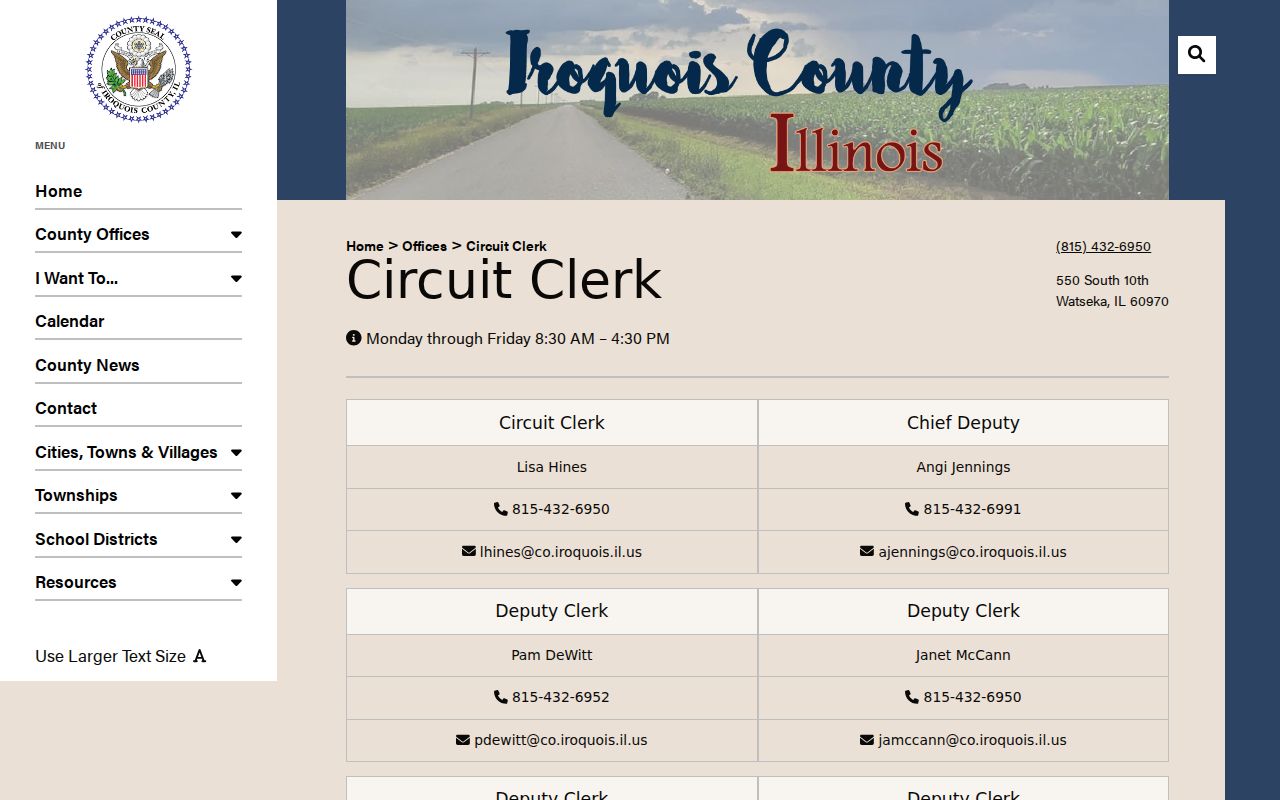
That pairing reflects the correct workflow: search first, then contact the custodian for a missing or certified court document.
Criminal Case Stages in Iroquois County
A local case can begin with an arrest or summons, followed by a prompt first appearance and a pretrial-release decision. The State's Attorney files a complaint or information, or seeks an indictment. Arraignment addresses the charges and plea. Discovery, motions, status hearings, and pretrial conferences follow before a plea or trial. Judgment and sentencing come after a guilty finding, with post-judgment motions and appeal possible.
Case flow: Charges Filed › Arraignment › Pretrial › Plea or Trial › Disposition › Sentencing
Illinois ended cash bail under its pretrial reforms. New Iroquois County court case records should be read in terms of release conditions, detention petitions, and judicial detention decisions. Older dockets may still use “bond” language because they record events under the rules then in force.
Iroquois County Pretrial Docket Terms
Release language changed after Illinois's Pretrial Fairness Act became operational. A current Iroquois County criminal case may show release conditions, a detention petition, a detention hearing, or an order to detain. Those entries replaced the old assumption that a defendant could always post a set cash amount. “Bond” can still appear on an older docket and in older forms, so its presence should be read against the event date.
The docket records what the judge ordered, not the private risk assessment or confidential supervision notes behind every recommendation. For the controlling result, open the order if public or request it from the Circuit Clerk. This keeps a brief status label from being mistaken for the full pretrial ruling.
Iroquois County Beyond Judici
re:SearchIL is the Statewide Document Repository, but it is not a complete replacement for the public Iroquois County trial docket. Its current remote-access model emphasizes reviewing-court documents and applies registration, login, and access-level rules. Local public case discovery still runs through the clerk's Judici link.
The official re:SearchIL entry screen appears in this source capture and helps mark the boundary between a statewide repository and the local trial-court search.
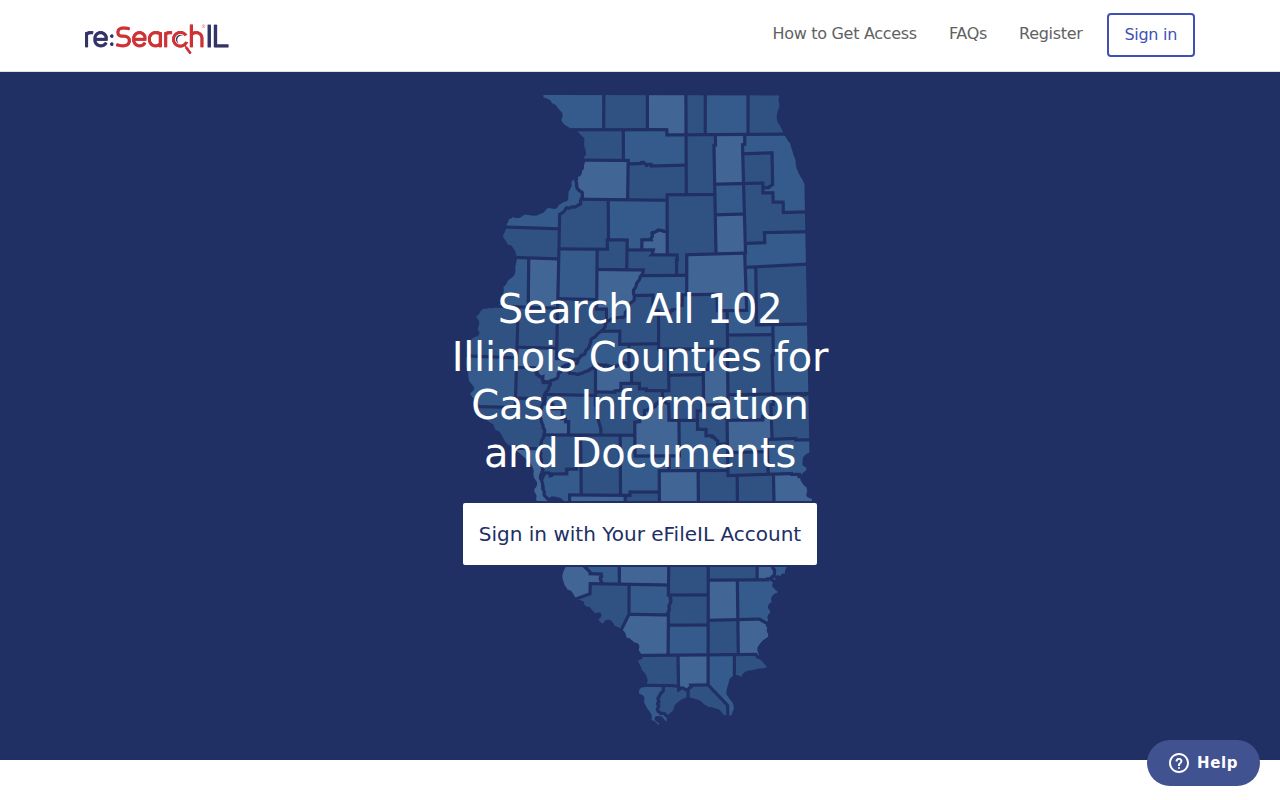
An Iroquois County criminal case may need both layers when a reviewing-court document matters, but Judici and the Circuit Clerk remain the local starting points.
Federal prosecutions are separate. Iroquois County lies in the Central District of Illinois, with venue generally routed through its Urbana Division. PACER provides the official federal docket channel shown here after registration.
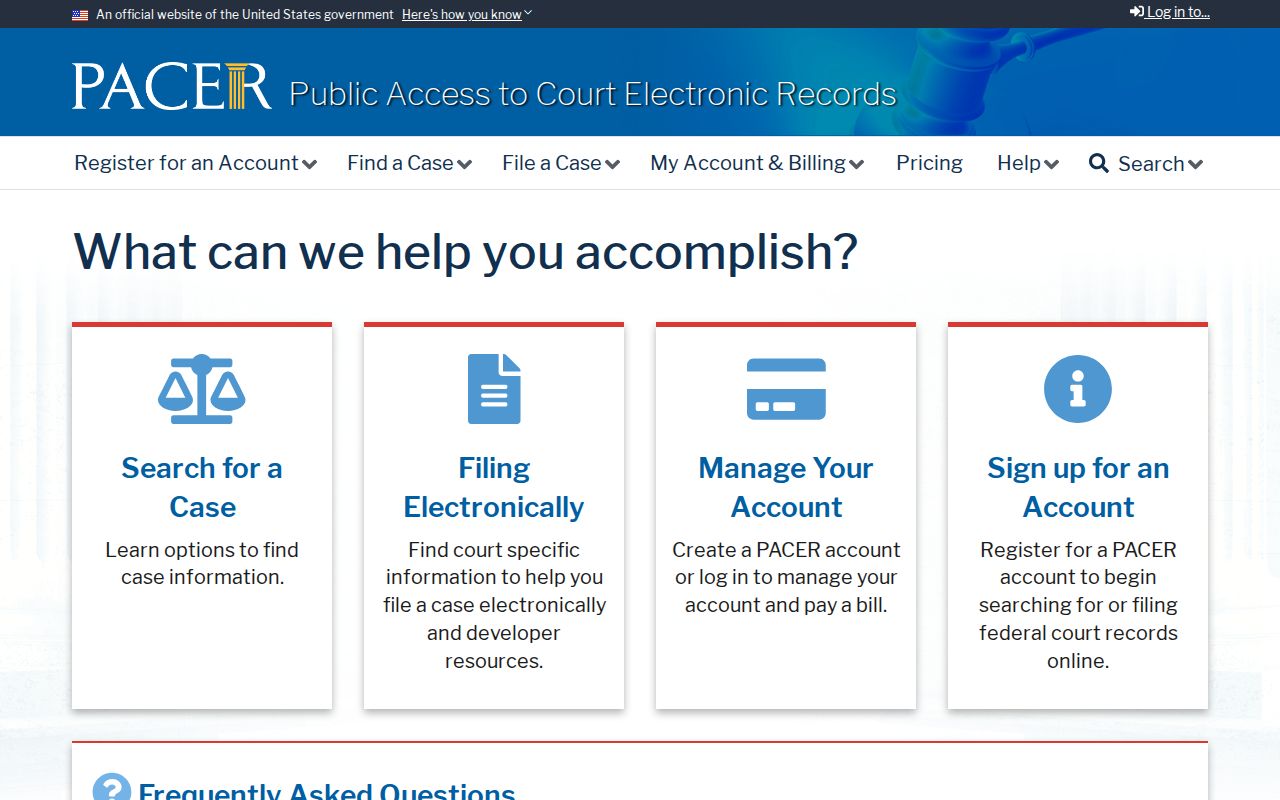
A PACER no-result says nothing about a county prosecution, just as a Judici search does not locate a separate federal case.
Access Rules for Case Records
Public access has firm limits. Sealed cases and confidential juvenile matters are excluded from ordinary public views. Full Social Security numbers, protected victim or minor information, financial account data, and other sensitive identifiers can be redacted. A record may also be available at the clerk even when no document image appears online. Illinois FOIA is not the tool for overriding a sealing order or court access rule.
Illinois law distinguishes expungement from sealing. Expungement can erase, return, or impound eligible arrest and case records as ordered, while sealing restricts general public access but preserves access authorized by statute. Iroquois County requests use the statewide form set and are filed with the Circuit Clerk. A blank search result alone proves neither remedy occurred.
When a court outcome does not appear on an Illinois State Police transcript, compare the Iroquois County court judgment with the repository entry. A subject can use ISP Access and Review and its Record Challenge process. This corrects the proper layer instead of treating a current local docket as proof that every state record has already updated.