
Iroquois County Criminal History Checks
No single screen contains every Iroquois County criminal record. Begin with the Judici search selected by the Circuit Clerk for filed local cases. A name search can reveal a case number, filing date, charge line and docket events. The clerk remains the source for a certified judgment or an older document that is not online. For a recent arrest, call the jail and contact the agency that made the arrest. Use the state repository only when Illinois conviction information or a review of your own fingerprint-linked transcript is the real goal.
Collect the full name, likely spelling variants, approximate event date and city before searching. Add a birth date only where an official form permits it. A shared name is not enough to identify a person. Match the case number, agency, charge date and disposition across the records that are legally public.
- Search the Iroquois County Judici docket by name, then repeat the search with the exact case number.
- Call the county jail for present custody or request a booking sheet from the sheriff.
- Ask the arresting police agency for its incident or arrest report.
- Read each filed count and its outcome instead of treating the booking charge as final.
- Use CHIRP for public Illinois conviction information or Access and Review for your own transcript.
Iroquois Criminal Records on South Tenth
Iroquois County concentrates three record functions at 550 South 10th Street in Watseka, but the shared address does not merge their files. Circuit Clerk Lisa Hines maintains court dockets, pleadings, orders and certified copies. Sheriff Clinton J. Perzee's office controls sheriff reports and responds through the county FOIA process. Jail staff answer current custody questions and create booking records. Sending one broad request to “the courthouse” can miss the correct custodian.
The Illinois Courts directory for the Iroquois County Courthouse confirms court contacts along with free parking, language access, disability coordination, a law library and remote-proceeding resources. The official directory view below helps identify the court source before a counter visit.
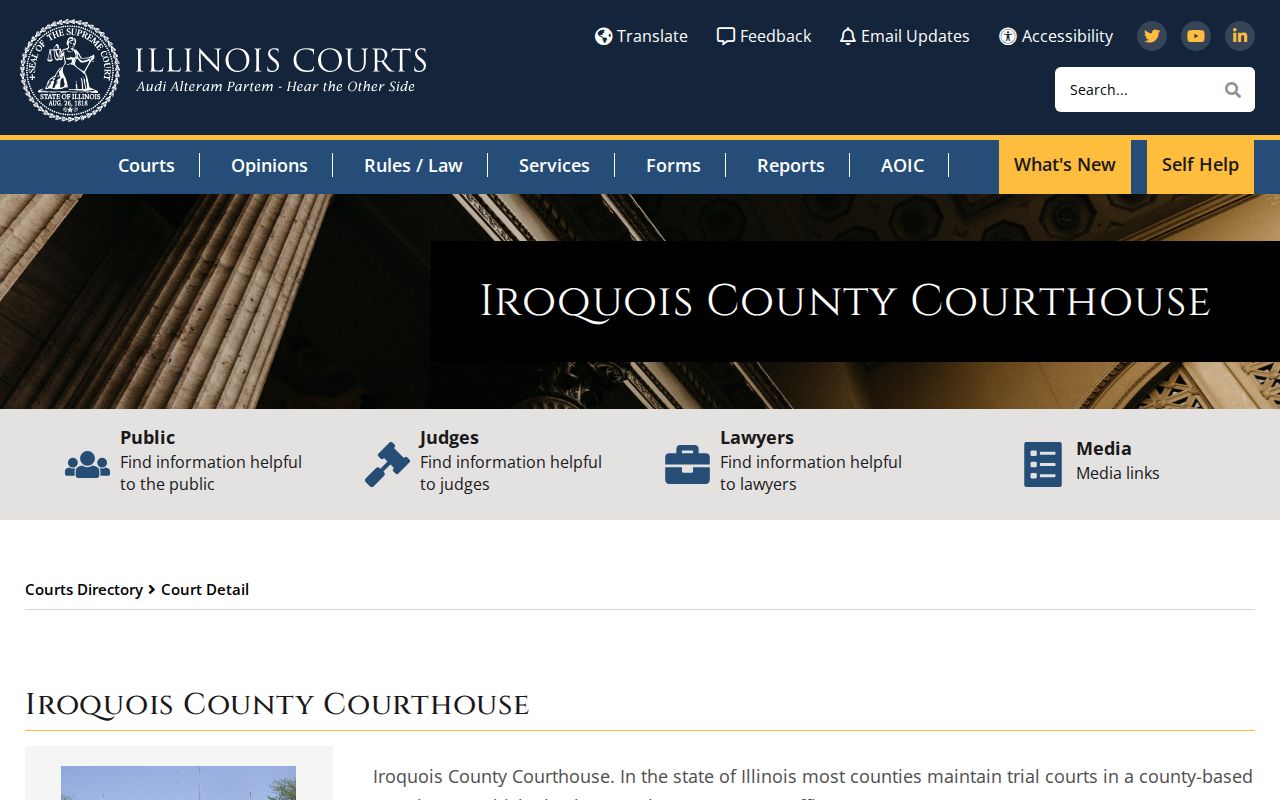
Those public services support court access, but a sheriff report or jail booking still has to be requested from its own holder.
Official Background Checks in Illinois
The Illinois State Police Division of Justice Services, Bureau of Identification is the central criminal-history repository. Its Criminal History Information Response Process, known as CHIRP, accepts public Uniform Conviction Information Act inquiries. A name-based electronic inquiry costs $10; the manual paper route costs $16. The result covers Illinois conviction information maintained by ISP. It is not an FBI file, a local police narrative, a complete Iroquois County court case, or every arrest that did not end in conviction.
Identity History Summary requests go to the FBI for a person's own federal record. Illinois Access and Review is the state route for inspecting your own transcript and challenging an error. Fingerprints may be submitted through a law-enforcement or correctional facility or an Illinois-licensed Live Scan vendor. ISP charges no processing fee for Access and Review, though the fingerprint provider may charge a service fee. Confirm the vendor's current license and service code before travel.
The official CHIRP entry screen shown here is the proper source for a UCIA transaction.
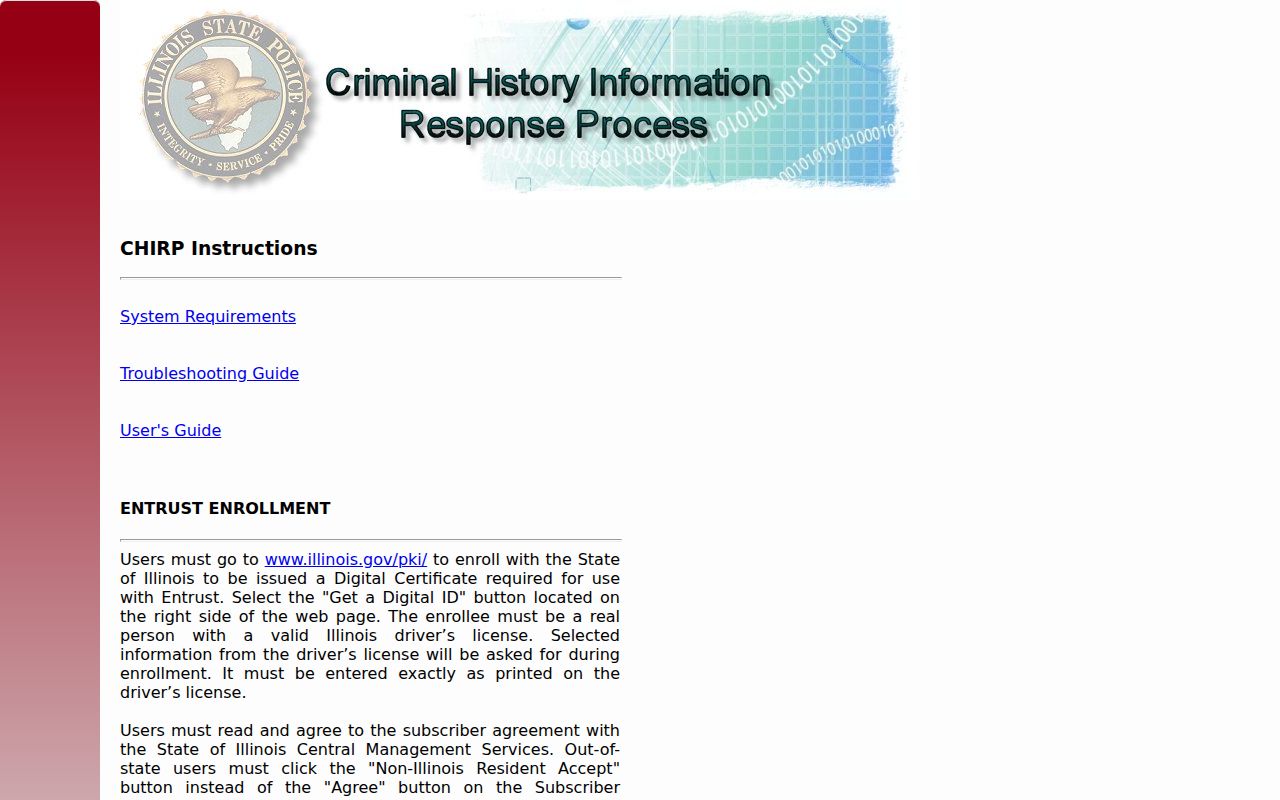
Save the transaction control number because ISP uses it to retrieve the response.
Reading Iroquois Criminal History Responses
CHIRP separates the request from response retrieval. Search options documented by ISP include the transaction control number, a date range, and first and last name. The control number is the strongest key because names can be shared, misspelled or changed. A returned conviction line should be compared with the Iroquois County court disposition when the local case matters. Reporting lag can leave the statewide cycle behind the clerk's current docket.
| Response field | How to use it |
|---|---|
| TCN | Retrieve the exact paid transaction and keep it with the response. |
| Date range | Narrow the response search to the time of the inquiry. |
| First and last name | Use as a fallback, then verify all identity and case details. |
| Conviction entry | Compare the charge, court and disposition with the local file. |
If your own transcript lacks a court outcome, ISP Record Challenge is the correction route. Get the final order from the circuit clerk first. Then identify the arrest cycle and provide the official disposition so BOI and the reporting agency can trace the mismatch.
Kinds of Criminal Records
Iroquois County criminal history is assembled from records created at different stages. Police document the reported event and arrest. The jail records intake and release. The State's Attorney chooses which counts to file, and the Circuit Clerk opens the court file. ISP BOI receives reportable arrest and disposition data for the state transcript. A later custody record may sit with the Illinois Department of Corrections, while registry information is maintained by ISP under a different law.
- Incident and arrest reports state what the agency reported, investigated and alleged.
- Booking records track county jail intake, presented charges, custody and release action.
- Circuit Court files hold filed counts, hearings, orders, outcomes and sentences.
- ISP transcripts compile reportable Illinois arrest cycles and later dispositions.
- Warrant, supervision and registry records remain with their named courts or agencies.
The official Iroquois County website routes readers to county offices rather than presenting one merged criminal-record database.
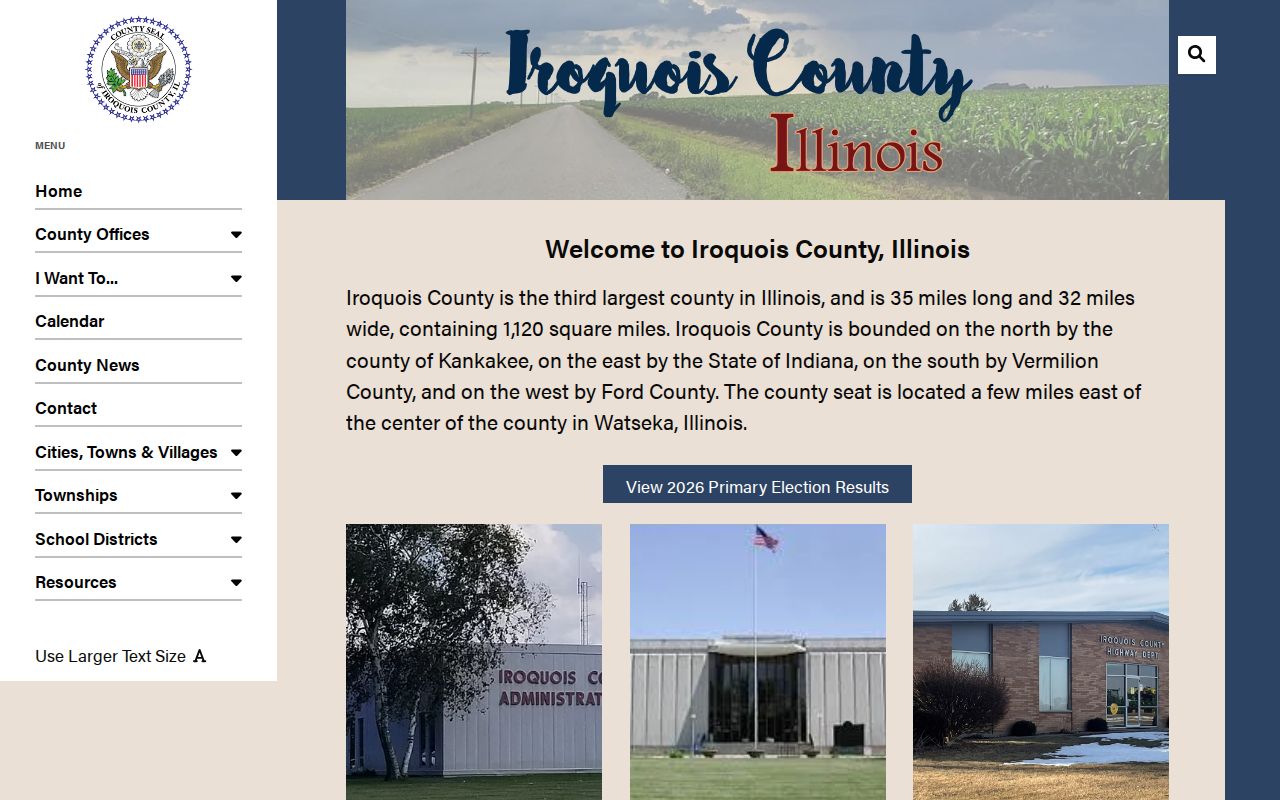
That office-by-office structure is why the event date and creating agency are useful search keys.
Four Iroquois Arrest Records
One arrest can produce four records without any being a duplicate. The arresting agency's narrative records the officer's basis and the event as first reported. The Iroquois County Jail booking records custody intake and the charges presented at that moment. The State's Attorney may file different or fewer counts, which appear in the Circuit Clerk's case. ISP BOI then receives fingerprints, arrest identifiers and later court disposition data.
Agency report → Jail booking → Circuit Court file → ISP transcript
A charge can therefore change from one stage to the next without proving that a source is wrong. Use the court judgment for the filed result, the jail for current local custody, and Access and Review for your own statewide cycle. The sheriff's official office page is the verified starting point for sheriff and jail contacts.
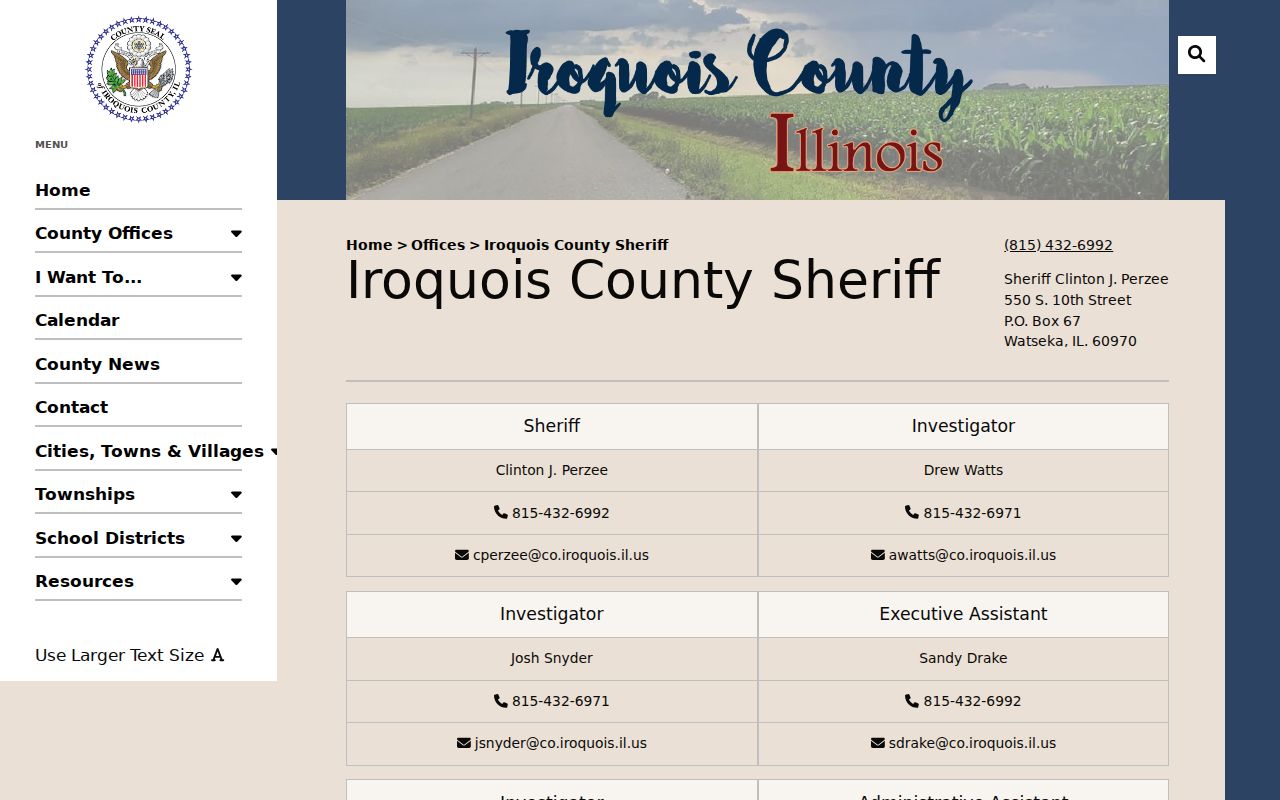
The sheriff page does not publish a searchable jail roster, so a phone call is a primary access channel here.
Iroquois County Criminal Records: What They Contain
The contents depend on the record. An Illinois transcript starts with identity and fingerprint keys, then groups arrest cycles, charges, outcomes and later correctional events. A court file is organized around a case number and docket. A booking entry focuses on intake and release. Public versions can omit Social Security numbers, protected addresses, victim or minor information, medical facts, sealed content and active-investigation material.
| Name and identifiers | Aliases, birth information, SID, FBI number or fingerprint keys where lawfully shown. |
|---|---|
| Arrest and booking | Date, agency, tracking number, presented allegations, intake and release action. |
| Charges and statutes | Each offense label, citation, class and amended or dismissed status. |
| Disposition | The outcome of each count, such as conviction, dismissal or acquittal. |
| Sentence | Custody, probation, assessments, restitution or other court-ordered terms. |
| Custody or supervision | Public jail, IDOC or docket status, not confidential case-management notes. |
No Iroquois County Jail Roster
The Iroquois County Sheriff's inspected pages did not expose an official current-inmate roster, booking blotter or automated custody line. Call the jail at 815-432-6970 to ask about present custody. A no-match can mean release or transfer, not that no arrest occurred. For a booking record, contact the sheriff under Illinois FOIA. Search Judici after prosecutors file a case, then use IDOC's locator only after a person enters state custody.
The 2024 IDOC jail inspection is a facility record, not a person lookup. It reports a rated capacity of 33, with 27 male and 6 female spaces, 11 double cells and two dorm areas. It also records a January 1, 1965 construction date. Do not use those inspection facts to infer who is housed today. Current visitation, mail, deposits, identification rules and phone providers must also be confirmed with jail staff.
Note: VINELink may provide notifications for participating custody data, but the jail remains the direct source for current Iroquois County confinement.
Illinois Public Access Laws
Illinois law assigns different access rules to agency reports, repository information, court files and registry data. Illinois FOIA is the request framework for records held by public bodies, but it does not override a sealing order or a confidentiality statute. UCIA makes conviction information maintained by ISP public, not every non-conviction arrest. Court remote-access policy excludes sealed and confidential material. Ask the office that maintains the record and state the event, date, location and preferred electronic format.
Key Statutes:
5 ILCS 140/3 and /6 set the Illinois FOIA request and copying-fee framework.
20 ILCS 2635/2 and /3 govern public ISP conviction information under UCIA.
20 ILCS 2630/5 and /5.2 address repository reporting and expungement or sealing.
730 ILCS 152/120 limits misuse of public registry information.
Iroquois Sheriff FOIA Requests
Illinois FOIA is the fallback for sheriff-created reports, booking data, dispatch material and other non-court agency records. No sheriff request form, dedicated FOIA email or universal submission rule was found. Contact Sheriff Clinton J. Perzee's office at 550 S. 10th Street or 815-432-6992 and ask whether a written request may be emailed or must be delivered to the office. The county's separate general FOIA form names Amanda Longfellow at 1001 E. Grant Street, but it should not be presented as a sheriff-specific form.
Ordinary noncommercial requests receive an answer within five business days, subject to a permitted five-business-day extension. The first 50 black-and-white letter or legal pages are free, with later pages at $0.15 each. Actual reproduction costs apply to oversized, color and electronic media. A precise request should give the report number if known, event date, time, location and record type. Ask for electronic delivery and a fee estimate before broad searches.
Note: Court records are not obtained through sheriff FOIA; request those from Circuit Clerk Lisa Hines at the same street address.
Restricted, Sealed & Expunged Records
Expungement and sealing create different results in Illinois. Expungement can erase, return or impound eligible arrest and case records as the order directs. Sealing removes eligible adult cases from ordinary public view while preserving access for agencies authorized by law. Juvenile files are generally confidential and follow separate rules. A missing online result alone does not prove that either remedy occurred.
File the approved statewide request, notice and order forms with the Iroquois County Circuit Clerk. List every arresting agency, arrest date, case number, charge and outcome. The local filing assessment must be confirmed at 815-432-6950. A current county fee PDF lists $120 in an existing case or $326 for a new MX case, but it says effective January 1, 2022 and should be checked before payment. ISP lists $60 to process a court order and no fee merely to file the petition.
The Illinois Courts expungement and sealing form suite is the official starting set.
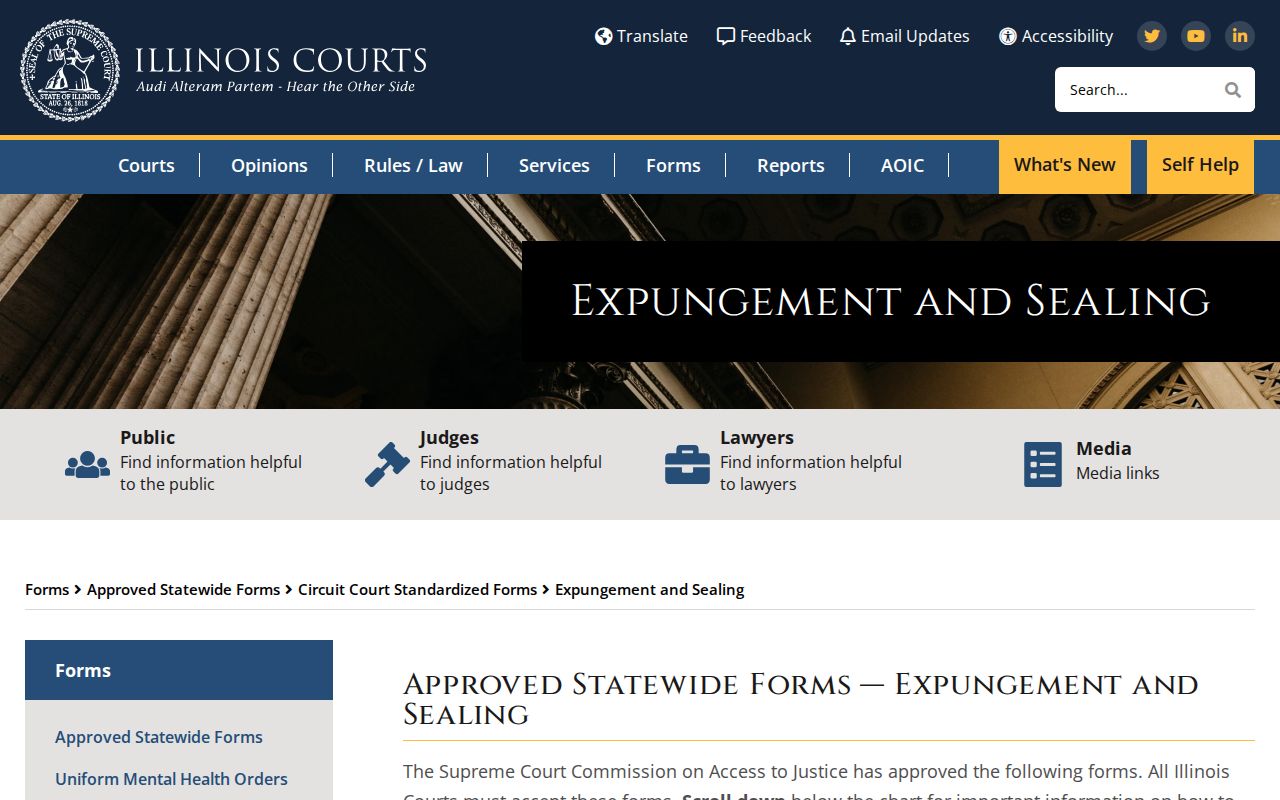
After an order, obtain certified copies and allow the clerk, arresting agencies and ISP time to update their separate systems.
Iroquois County Warrant Checks
No official county public warrant-search screen was found. Call the sheriff at 815-432-6992 for safe confirmation instructions, search the related Judici court docket, and call the Circuit Clerk at 815-432-6950 for public case status. A bench warrant can follow a missed appearance or failure to comply. An arrest warrant rests on a probable-cause finding, while a search warrant authorizes a search and may remain sealed before execution.
Operational LEADS data is not a public statewide portal. Public fields, when released, may include the name, case or warrant number, issuing court, issue date, reason and status. Juvenile, sealed and unexecuted-investigation details may be withheld. Someone worried about their own warrant should verify the exact case and current release or detention procedure with counsel, the court or sheriff before appearing. Old advice to “pay the bond” may be wrong because Illinois pretrial-release law changed.
Search Iroquois Cases on Judici
The Iroquois County Circuit Clerk and Illinois Courts both link Judici for public local docket access. Search by name first, then use the exact case number to reduce false matches. Read each count on its own. “Disposed” means the court entered an outcome; it does not always mean conviction. A docket entry also does not guarantee that the filed image is free to download.
| Search detail | What it resolves |
|---|---|
| Name and spelling | Finds candidate cases, including common-name matches. |
| Case number | Returns the most precise Iroquois County docket. |
| Case type | Codes include CF, CM, DT, DV, MT, OV, QC, TR and MX. |
| Count status | Shows whether each charge was amended, dismissed or resolved. |
The officially linked Iroquois search form provides the local public entry point.
For a certified judgment, an older image or a record omitted online, ask the clerk about counter or mail fulfillment and current fees.
Review Your Iroquois Criminal Record
Access and Review lets a person inspect their own Illinois State Police transcript. Fingerprints establish identity more reliably than a name. Use a law-enforcement or correctional facility or a licensed Live Scan vendor, then follow the current ISP steps. No licensed storefront was confirmed within Iroquois County during research, so check the state vendor list and call before travel. ISP has no Access and Review processing fee, but a fingerprint vendor may charge.
The ISP own-record instructions distinguish review from a public UCIA conviction inquiry.
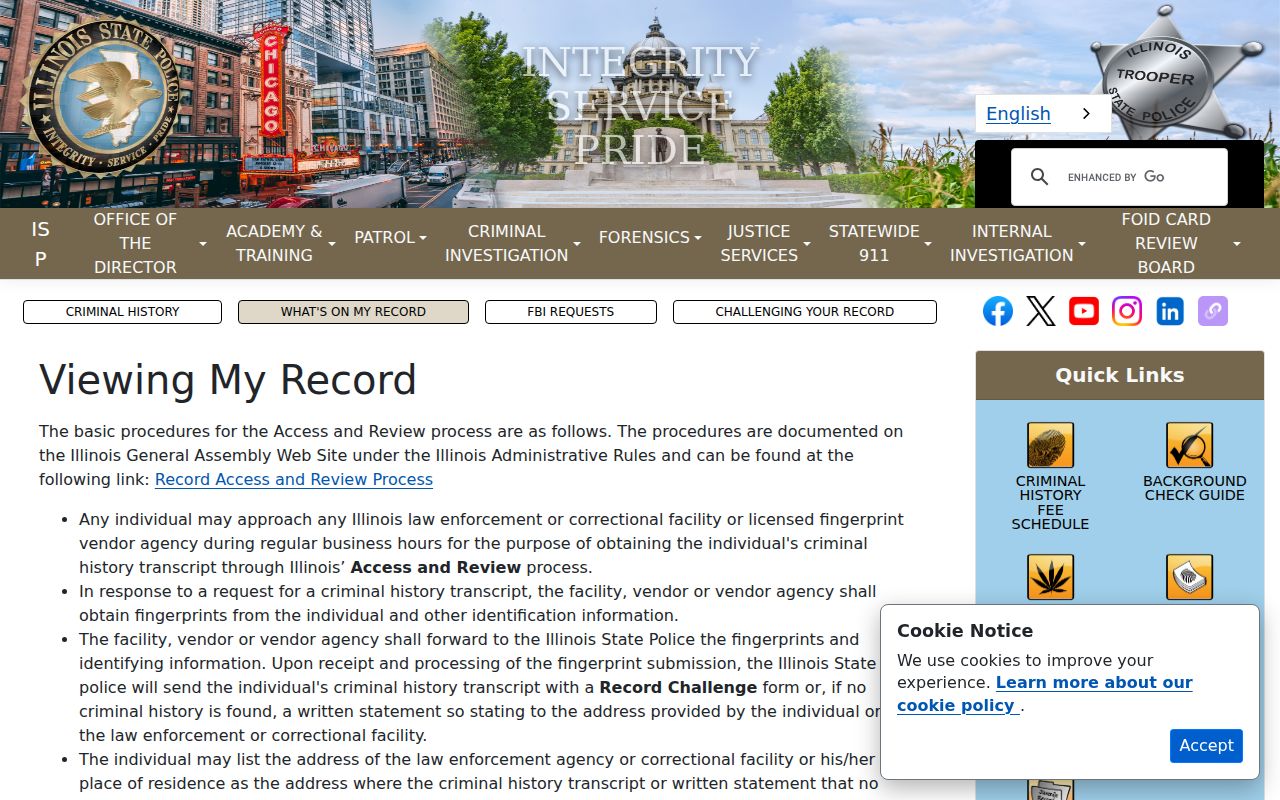
If an Iroquois County disposition is missing, obtain the clerk's final order and use ISP Record Challenge to connect it with the correct arrest cycle.
- Disposition
- The recorded outcome of a charge or case.
- Nolle prosequi
- A prosecutor's decision not to proceed on a charge at that time.
- Sealing
- A limit on general public access that preserves access authorized by law.
- Expungement
- Erasure or impoundment of an eligible record as the court order directs.
City-by-City Criminal Records in Iroquois County
Watseka, Gilman and Onarga are the three largest incorporated places in the 2020 Census ranking used for the city pages. Their local record paths differ. Watseka maintains a police department and public FOIA form. Gilman has contracted with the Iroquois County Sheriff for police protection since 2021, so sheriff records matter more than stale references to a city police desk. Onarga has a police agency, but no verified village portal or current online request details were found.
Watseka Record Check
4,679 in 2020 · City police reports route to the county jail and Circuit Court.
Gilman Record Check
1,733 in 2020 · County sheriff contract records and city clerk files use distinct routes.
Onarga Record Check
1,333 in 2020 · Village police reports lead to county custody and court sources.
Rural Iroquois Record Routes
Iroquois County covers 1,117.40 land square miles and had 27,077 residents in the 2020 Census. The July 1, 2025 estimate was 26,150, a 3.4 percent decline from the estimate base. Arrests can begin with city police, the sheriff, Illinois State Police, conservation police or a federal agency across this large county, yet filed local cases converge in the 21st Judicial Circuit at Watseka.
Highway activity near Interstate 57 at Gilman and routes through Watseka and Onarga can place traffic, impaired-driving and drug matters in the same Circuit Court even when different agencies made the stop. Statistics must therefore keep the agency, year, coverage and reporting completeness attached. A city police offense count cannot be compared with a county-wide sheriff rate as if their boundaries were the same.